
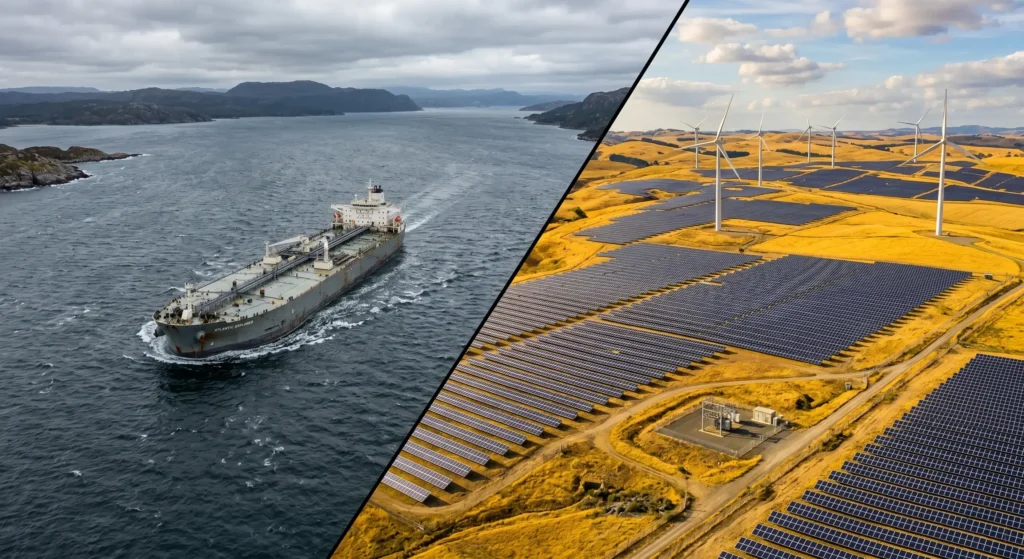
Wars don’t usually come with silver linings. But the conflict that erupted in late February 2026, when US and Israeli airstrikes hit Iran and the Iranian military responded by effectively closing the Strait of Hormuz, is reshaping global energy in a way that years of climate summits and government pledges never quite managed to.
The disruption has been enormous. About 20% of the world’s oil and liquefied natural gas normally transits the strait every single day — tankers from Saudi Arabia, Qatar, Kuwait, the UAE, heading mostly to Asia. Since early March, that flow has dropped to a trickle. Oil prices have hovered around $100 a barrel, roughly 50% higher than before the war began. Diesel costs have shot up even higher in parts of Asia. In the Philippines, Japan, South Korea, and Bangladesh, the disruption isn’t an abstraction — it’s shortages, rationing, and surging electricity bills.
What nobody expected — or at least not this quickly — was how decisively countries would respond. Not by scrambling for alternative fossil fuel supplies, but by doubling down on solar, wind, batteries, and electrification.
Key Numbers at a Glance
- ~20% of global oil and LNG normally passes through the Strait of Hormuz
- 85.6% of all new global power capacity in 2025 came from renewables (IRENA)
- 25+ countries have enacted new clean energy measures since the Iran crisis began
- $100/barrel — Brent crude price since late February 2026
The Biggest Supply Shock in Modern History
The International Energy Agency called it the “largest supply disruption in the history of the global oil market.” That’s not hyperbole — the 1973 Arab oil embargo cut off about 7% of global supply. The Hormuz closure has affected five times that volume.
The immediate fallout has been worst in South and Southeast Asia. Over 80% of the oil and LNG transiting Hormuz is bound for Asian markets, which means countries like Pakistan, Bangladesh, Sri Lanka, Japan, and South Korea absorbed the sharpest blow. Vietnam saw fuel shortages and panic buying. The Philippines, which imports most of its LNG from the Middle East to run power plants, faced the prospect of rolling blackouts.
Europe got hit too, but differently — rising LNG prices and concerns about jet fuel supply rather than outright shortages. Africa, already stretched, faced higher fuel and fertilizer costs that started feeding into food prices. Even the US, now largely energy-independent on paper, watched domestic gasoline rise by over a dollar per gallon as global refinery economics rippled through.
Context: The last comparable shock — Russia’s invasion of Ukraine in 2022 — pushed Europe to cut gas dependency and accelerate renewables. Analysts at the Institute for Energy Economics and Financial Analysis (IEEFA) are already calling the Hormuz crisis “Asia’s Ukraine moment.”
Why This Crisis Is Different From the 1970s
The obvious historical comparison is the 1973 oil shock — a geopolitical disruption that sent governments scrambling for alternatives and produced a sustained interest in nuclear power and energy efficiency. That response took years and billions, and nuclear plants didn’t come online for a decade or more.
The 2026 situation is different in one critical way: the alternatives already exist, they’re cheap, and they can be deployed fast.
“If you go back to the 1970s, what did we do? We built nuclear, but that took 10 years, and it was expensive. This time round, we’ve got solar and wind, batteries and electrification, and lots of flexible technologies, which are huge and cheap, and we can scale them. And that’s what’s happening.” — Energy analyst, quoted by CNBC
Solar panel prices have dropped over 90% since 2010. A 2025 UN analysis found that over 90% of new renewable energy projects are now cheaper than equivalent fossil fuel projects. Wind turbines, battery storage, heat pumps, electric vehicles — none of these existed at commercial scale or competitive price points in 1973. They do now.
And crucially, they don’t transit the Strait of Hormuz.
The Acceleration in Numbers
Even before the war, the trajectory was steep. IRENA reported that renewables accounted for 85.6% of all new power capacity installed globally in 2025, and that renewables now make up 49.4% of the world’s total energy capacity, up from 46.3% the year before. Wind and solar were already on track to overtake natural gas in global electricity production by the end of 2026.
The war accelerated that. Chinese exports of solar panels, EV batteries, and electric vehicles rose 70% year-over-year in March 2026, according to energy think tank Ember. The Philippines tripled its solar PV imports from China in Q1 2026 compared to the same period last year. Japan, Nepal, and Bangladesh all recorded their highest-ever imports of clean energy technology in Q1 2026.
Change in Solar PV Imports — Q1 2026 vs Q1 2025 (Selected Countries)
| Country | Change | Notes |
|---|---|---|
| Philippines | +200% | Tripled solar PV imports from China |
| Bangladesh | Record high | Highest-ever clean tech imports |
| Nepal | Record high | Highest-ever clean tech imports |
| Japan | Record high | Highest-ever clean tech imports |
| China EV exports to Asia | $2.2B (Apr 2026) | New record high |
Source: Zero Carbon Analytics; Ember analysis of Chinese customs data
Region by Region: How the World Is Responding
| Region | Immediate Impact | Clean Energy Response |
|---|---|---|
| Asia-Pacific | Worst-hit. LNG shortages, fuel rationing, price spikes. 80%+ of Hormuz exports go here. | Record solar PV imports; EV uptake surge; government subsidies for rooftop solar |
| Europe | Jet fuel shortage concerns; LNG price rises; household energy bills up ~10% | UK mandating heat pumps and solar in new homes; Poland investing in nuclear and wind |
| United States | Gas prices up $1+/gallon; diesel up ~50% since Hormuz closed | EV interest rebounding; grid-scale battery investment continuing |
| Africa | Pakistan, Bangladesh, and Sri Lanka face acute shortages | Some countries using crisis to attract infrastructure and renewable investment |
| South Asia | Pakistan’s pre-existing residential solar boom is now a critical buffer | UK mandating heat pumps and solar in new homes; Poland is investing in nuclear and wind |
The Countries That Were Already Prepared
The countries that invested in clean energy over the past decade are faring considerably better than those that didn’t.
Pakistan is a useful case. The country has faced chronic energy crises for years, and a combination of affordability pressure and cheap Chinese solar panels led to a quiet residential solar boom between 2019 and 2025. The total generating capacity of solar panels imported during that period actually exceeded Pakistan’s existing installed power capacity. That pre-existing distributed generation is now functioning as a critical buffer against the Hormuz shock.
Countries with strong domestic electricity grids powered by renewables — Uruguay, Costa Rica, Iceland — are essentially insulated from the oil price spike for everyday electricity needs. The pain they feel is mostly through transport fuels and industrial feedstocks, a much narrower exposure than countries running gas-peaking plants to keep the lights on.
“Every country has homegrown access to at least two clean energy resources — the sun shines and the wind blows just about everywhere. The same cannot be said of oil and gas, where production is concentrated in a small number of countries and exposed to geopolitical disruption.” — World Resources Institute, April 2026
The IEA’s Reading: A “Profound Transformation” Ahead
IEA Executive Director Fatih Birol has been direct about what he thinks this means. Speaking in Australia in late March, he said he expected “one of the responses to this crisis will be an acceleration of renewables — not only because they help reduce emissions, but because they are a homegrown, domestic energy source.”
In a later interview with Le Figaro, Birol went further: “The geopolitics of energy will be profoundly transformed.” He noted the energy transition was already moving “very strongly” before the war, but the Hormuz crisis has added a second, harder-to-ignore driver: pure energy security.
“Ten years ago, solar was a romantic story — but now solar is a business.” — Fatih Birol, IEA Executive Director
His estimate: scaling up electric vehicles across Asia alone could save importers more than $600 billion annually in oil costs. That’s not a climate argument. That’s a financial one.
The China Factor
One dimension of this shift that gets less attention: China is the primary beneficiary. As the world scrambles for solar panels, EV batteries, wind turbines, and battery storage systems, almost all of that supply chain runs through Chinese manufacturing.
Chinese exports of solar, batteries, and EVs rose 70% year-over-year in March. China’s EV exports to Asia hit a new record of $2.2 billion in April. Analysts at Columbia University’s Center on Global Energy Policy have noted that the Iran war could “consolidate China’s energy dominance,” shifting geopolitical dependence from Middle Eastern oil exporters to Chinese clean technology manufacturers.
For most energy-importing nations, diversifying away from a concentrated, conflict-prone choke point is a straightforward improvement — even if it creates new dependencies.
The Numbers That Tell the Real Story
According to energy think tank Ember, Chinese exports of solar panels, batteries, and electric vehicles all hit record highs in March 2026. China’s customs data backs this up with some striking year-on-year figures:
| Product Category | Year-on-Year Growth (March 2026) | Notable Markets |
|---|---|---|
| Solar cells | ~80% | Europe, Middle East, Southeast Asia |
| Lithium-ion batteries | ~34% (reaching $10B in March) | EU, Australia, India |
| Electric vehicles | ~53% | Global, especially emerging markets |
Source: China General Administration of Customs, via Bloomberg
A jump like this doesn’t happen because of marketing campaigns or subsidies alone. It happens when buyers — governments, utilities, and businesses — suddenly recalculate their risk tolerance for fossil fuel dependence.
Where Investment Capital Is Flowing
Key Policy and Investment Responses Since March 2026
| Country / Bloc | Action | Technology Focus |
|---|---|---|
| European Union | Fast-track permitting; energy transition reframed as security policy | Solar, wind, batteries |
| United Kingdom | Rooftop solar drive in the residential and commercial sectors | Heat pumps, rooftop solar |
| Poland | New investment in wind and nuclear announced | Wind, nuclear |
| Philippines | Government subsidies for household solar; PV imports tripled | Distributed solar |
| Japan | Emergency clean energy fund; record clean tech imports | Solar, hydrogen |
| India | Accelerated domestic solar manufacturing and grid storage | Solar, batteries |
| Vietnam | Rooftop solar drives in the residential and commercial sectors | Rooftop solar |
| South Korea | Expanded offshore wind tender; emergency EV incentive program | Offshore wind, EVs |
A poll by the UK Sustainable Investment and Finance Association (UKSIF) found investors overwhelmingly expect financing for renewable energy projects to surge following the conflict. Singapore’s Climate Action Ambassador Ravi Menon put it bluntly: “You need a price signal, and then capital and investments will flow into this.” The price signal arrived in late February. Capital is now responding.
The Near-Term Complications
It would be dishonest to only tell the acceleration story. There are real complications.
First, governments under pressure have reached for short-term fixes that cut against long-term goals. Fuel duty suspensions and consumer energy subsidies ease immediate pain but also reduce the price signal that makes clean energy attractive. Some countries have quietly opened conversations about coal restarts.
Second, supply chain pressure on solar components and batteries could create bottlenecks. Demand has surged faster than manufacturing capacity can expand.
Third, in conflict-adjacent regions, infrastructure investment of any kind has become riskier and more expensive to insure.
As Federica Genovese, professor of political science at the University of Oxford, noted: “The EU is trying to push member states toward an energy transition — now framed as an energy security and economic resilience mechanism — but it remains to be seen if countries will follow through.”
The momentum is real. So is the inertia.
The Longer Arc
The 2022 Ukraine war pushed Europe to cut Russian gas dependency faster than anyone thought possible. Two years later, Europe’s gas demand was measurably lower, and its renewables share measurably higher.
The Hormuz crisis is a larger shock hitting a larger set of countries. The IEA’s own modelling concluded that when energy security becomes a primary concern, the pace of the energy transition speeds up — because the policies that improve energy security (domestic renewables, efficiency, electrification) also reduce fossil fuel dependency.
DNV put it simply: “The rule-of-thumb that what is bad for fossils is good for renewables applies. And the Middle East conflict is definitely bad for oil and gas.”
That doesn’t mean the transition is clean or linear. But the directional pull — toward energy sources that aren’t controlled by foreign governments, that don’t transit narrow straits, that don’t send price signals from a war zone — has never been more economically compelling than it is right now.
Scaling up EVs across Asia alone could save the region more than $600 billion per year in oil imports, according to IEA Executive Director Fatih Birol.
Frequently Asked Questions
-
Why has the Iran war affected global energy so severely?
The conflict effectively closed the Strait of Hormuz, through which roughly 20% of the world’s oil and LNG normally transits daily. No other trade route can absorb that volume, and no alternative swing producer can replace it at scale in the short term. The IEA described it as the largest supply disruption in the history of the global oil market.
-
Which countries are most affected?
Asia is bearing the brunt — over 80% of the oil and LNG passing through Hormuz is destined for Asian markets. The most acute impacts have been in the Philippines, Japan, South Korea, Bangladesh, Pakistan, and Sri Lanka. Europe has seen rising LNG and jet fuel costs. The US has experienced a significant rise in domestic gasoline prices.
-
How quickly can clean energy replace fossil fuel imports?
For electricity generation, relatively fast — solar and wind can be installed in months. For transport fuels, the shift is slower, requiring both EVs and charging infrastructure. Birol estimated the full geopolitical transformation would “take years” but said many countries could begin shifting meaningfully within months.
-
Is China benefiting from the crisis?
Yes, significantly. China dominates global manufacturing of solar panels, EV batteries, wind turbines, and electric vehicles. Chinese clean-tech exports rose 70% year-over-year in March 2026. Most energy importers see this new dependency as preferable to the current exposure through the Strait of Hormuz.
-
Could this crisis actually slow the energy transition?
In the very near term, yes — fuel tax cuts reduce the price advantage of clean energy, and supply chain pressures on solar and batteries are real. But the longer-term consensus is strongly positive for the transition, as the crisis has made energy security — not just climate — the primary argument for going clean.
-
What does this mean for fossil fuel investment in the long term?
The structural trend is toward reduced fossil fuel investment as governments prioritise domestic, stable-cost energy sources. DNV’s modelling shows that when energy security becomes the primary policy driver globally, renewables benefit most.
Sources: IEA (iea.org) | IRENA (irena.org) | World Resources Institute (wri.org) | DNV Energy Transition Outlook (dnv.com) | Carbon Brief (carbonbrief.org) | Ember (ember-energy.org) | Atlantic Council | CNBC | CNN | Bloomberg | Fortune | Rolling Stone
Published by greenenergynews.xyz — For informational purposes only. Not financial or investment advice.