
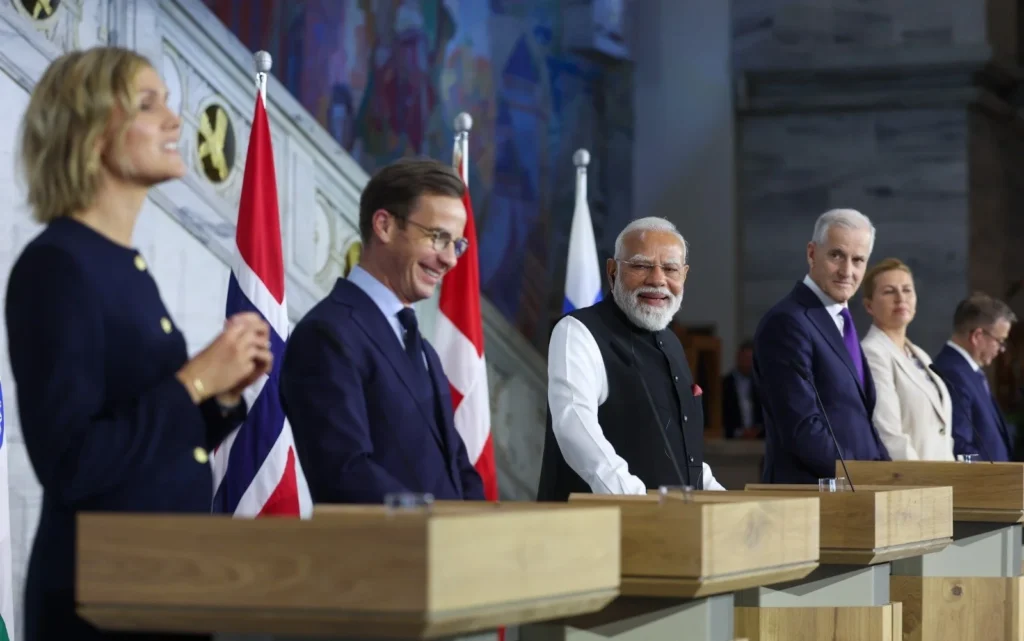
The 3rd India-Nordic Summit in Oslo produced a new strategic partnership that stretches well beyond trade — here’s what it actually covers.
📅 May 20, 2026 | 📍 Oslo, Norway | ⏱ 10 min read
When Prime Minister Narendra Modi flew into Oslo for the 3rd India-Nordic Summit this week, the five Nordic nations — Denmark, Finland, Iceland, Norway, and Sweden — weren’t just waiting with pleasantries. They came with a formal framework: a Green Technology and Innovation Strategic Partnership that puts climate cooperation on something closer to an institutional footing.
What Happened in Oslo
The summit, held on May 19–20, 2026, was the third of its kind since the India-Nordic format was established eight years ago. Modi met separately with the leaders of Norway, Iceland, Finland, and Denmark on the sidelines before the joint session, which produced a detailed joint statement and the announcement of the new strategic partnership.
The joint statement is unusually specific about what the two sides plan to do together. Rather than the usual diplomatic language about “exploring opportunities,” it names concrete sectors: renewable energy, green hydrogen, carbon capture, critical minerals, geothermal, blue economy, Arctic research, cybersecurity, 5G/6G, and advanced manufacturing.
“Today, we decided to elevate India-Nordic relations to a Green Technology and Innovation Strategic Partnership. With this green technology partnership, we will ensure a better future for the entire world.” — Prime Minister Narendra Modi, Oslo, May 20, 2026
Norwegian Prime Minister Jonas Gahr Støre framed the partnership around the geopolitical moment — democracies finding common ground amid instability — and noted the growing alignment between countries that share both governance values and economic interests in a clean energy transition.
Areas of Cooperation
The partnership covers six broad areas of joint work. They aren’t all at the same stage of development, and it’s worth being honest about which ones are well-established versus mostly aspirational right now.
⚡ Renewable Energy & Green Hydrogen Cooperation on solar, wind, green hydrogen production, and storage — with Nordic financing increasingly directed toward Indian infrastructure projects.
🌋 Geothermal Energy Iceland’s geothermal expertise — it runs almost entirely on geothermal and hydro — is an area India wants to tap for its volcanically active northeastern regions.
🌊 Blue Economy Marine resource management, sustainable fisheries, and offshore energy — both sides see commercial value and conservation imperatives here.
🔬 Carbon Capture & Critical Minerals Norway leads in CCS technology. India needs it for hard-to-abate industries. Critical minerals are a supply chain issue both blocs have reason to work on together.
🛡️ Cybersecurity & Telecom Cooperation on 5G/6G standards, network security, and trusted infrastructure — an area where democratic alignment matters as much as technology.
🧊 Arctic & Polar Research India is an observer at the Arctic Council. The Nordic nations want closer India engagement as Arctic changes increasingly affect the Indo-Pacific too.
Note on Space Cooperation: The summit also saw a framework agreement between ISRO and the Norwegian Space Agency on peaceful uses of outer space, plus a proposal for a Swedish payload on India’s Venus Orbiter Mission.
India’s Renewable Energy Position
India’s energy story over the past decade has been one of genuine, measurable growth — not just announced targets. The country hit its COP26 commitment of 50% non-fossil fuel electricity capacity in June 2025, five years ahead of schedule. As of late 2025, renewables account for roughly half of India’s total installed power capacity of around 484 GW.
| Metric | Figure |
|---|---|
| Global rank in renewable energy installed capacity | 3rd (IRENA, 2026) |
| Solar capacity (December 2025) | 135 GW |
| Wind energy installed capacity (2025) | 50+ GW |
| Non-fossil fuel target by 2030 | 500 GW |
| Renewable capacity added in FY 2024–25 | 29.5 GW (record) |
| Solar module manufacturing capacity (2025) | 74 GW |
The caveat worth noting: renewables make up about half of installed capacity, but still only around one-fifth of actual generation, because solar and wind run at 17–22% utilization rates while coal runs at 70%. Closing that gap by 2030 requires India to roughly double its annual capacity additions — a steep ask, but not impossible given the recent trajectory.
India’s Renewable Energy Capacity Growth
| Year | Installed Non-Fossil Capacity |
|---|---|
| 2014 | 76 GW |
| 2020 | 140 GW |
| 2024 | 217 GW |
| 2025 | 250 GW |
| 2030 Target | 500 GW |
Sources: PIB India, IRENA RE Statistics 2026, IBEF
Where Nordic Countries Stand
The five Nordic nations have very different energy profiles, but share one unusual distinction: all of them already exceed the EU’s 2030 renewable energy target of 42.5% of gross final energy consumption, a threshold they hit in 2023. That’s what makes them credible partners rather than just aspirational ones.
Renewable Energy Share — Nordic Nations vs. India
| Country | Renewable Share | Primary Source |
|---|---|---|
| Iceland | 79.5% | Geothermal + Hydro |
| Norway | ~99% (electricity) | Hydropower |
| Sweden | ~66% | Hydro + Nuclear + Wind |
| Denmark | 63% (solar + wind of electricity) | Offshore Wind |
| Finland | 50%+ | Biomass + Hydro |
| India | ~50% (installed capacity) | Solar + Wind |
Sources: Nordic Statistics, Nordic Energy Research, IBEF 2025
Country-by-Country Breakdown
| Country | Key Expertise for India | Business Presence in India |
|---|---|---|
| Norway | Carbon capture & storage, offshore energy transition | TEPA implemented October 2025 |
| Denmark | Offshore wind, district heating, smart urban systems | ~200 Danish companies invested in India |
| Sweden | Green steel, battery storage, industrial electrification | Volvo, Ericsson, Electrolux, SKF |
| Finland | Clean manufacturing, forest carbon management | 100+ Finnish companies; Nokia, Wartsila, KONE |
| Iceland | Geothermal systems, carbon mineralisation | EFTA member; TEPA with India since March 2024 |
Trade and Investment Picture
Modi’s Oslo remarks included a number worth taking seriously: bilateral trade between India and Nordic nations has roughly quadrupled over the past decade. Nordic investment into India is up about 200% over the same period.
The Trade and Economic Partnership Agreement (TEPA) between India and the European Free Trade Association — which includes Norway, Iceland, Switzerland, and Liechtenstein — came into force in October 2025 for Norway and was signed in March 2024. The Nordic side of EFTA now operates under a formal trade framework with India, which changes the investment calculus for smaller Nordic firms that previously faced more friction entering the Indian market.
Several large sovereign and pension funds from Norway and Sweden — including Norges Bank Investment Management, the world’s largest sovereign wealth fund — are increasingly allocating to Indian renewable energy projects. Modi specifically called out Nordic investment funds as “becoming key partners in India’s rapid growth.”
AI, Space, and Arctic Research
The green energy framing gets most of the headlines, but the technology dimension is arguably just as significant.
On AI, the joint statement calls for inclusive, transparent, and “human-centric” AI governance — language that aligns India and the Nordic bloc on governance philosophy, not just the commercial side. Both India (which hosted the AI Impact Summit in February 2026) and Nordic countries are active in multilateral AI governance conversations.
The Arctic dimension is less obvious but probably the most underappreciated part of the agreement. India has been an observer at the Arctic Council since 2013, and climate change is making the Arctic-Indo-Pacific connection increasingly material — Arctic ice loss affects monsoon patterns, ocean circulation, and storm systems that matter enormously to India. The joint statement explicitly acknowledges “increasing linkages between the Arctic and Indo-Pacific regions.”
Why This Partnership Has Real Weight
Diplomatic summits produce a lot of paper. This one is worth paying attention to for a few specific reasons.
The complementarity is genuine. India has scale, manufacturing ambition, and growing capital markets. Nordic countries have technology depth, financing capacity, and operational expertise in exactly the sectors India is building out. The geothermal gap is a good example: India has volcanic potential in the northeast that’s barely been exploited, and Iceland has decades of operational knowledge.
The trade architecture now exists. TEPA gives Norway and Iceland formal market access frameworks. The India-EU free trade agreement expands that further for Sweden, Finland, and Denmark.
Private sector interest is real. Fortum (Finland), Ørsted (Denmark), Equinor (Norway), and Stegra (Sweden — building the world’s first large-scale hydrogen-based steel plant) are already engaged in Indian markets or adjacent supply chains.
The Nordic countries are small in terms of GDP. But in green technology, they’re disproportionately large by expertise and institutional depth. If India is serious about hitting 500 GW by 2030 while building out a domestic manufacturing base, partnerships with countries that have already done the hard parts of energy transition — not just capacity addition, but grid integration, financing structures, and industrial retrofitting — are worth more than they might look from the outside.
The third India-Nordic Dialogue is scheduled to be hosted in India in 2026. That’s the next concrete checkpoint.
Further Reading:
- India Ministry of External Affairs: https://www.mea.gov.in
- Nordic Energy Research: https://www.nordicenergy.org
- India Ministry of New & Renewable Energy: https://mnre.gov.in
- European Free Trade Association (EFTA): https://efta.int
- Global Energy Monitor: https://globalenergymonitor.org
- IRENA Renewable Energy Statistics: https://www.irena.org
This article is informational and based on publicly available summit statements, trade data, and energy reports current as of May 2026.